Non-chemical water treatment units for industry EZV, EZV T, M, MT, C, A
English
Aktualizované:
English
 her substances. The so-called water hardness depends on the volume of individual elements organisms as well as for plants, however, their precipitation from water causes serious problems due to solid incrustations in water pipings, warmwater systems, laundries, refrigerating systems, etc. Incrustations are formed mainly due to heating hard water, which results in reduced piping diameter, impeded heat flow, and subsequently, higher power losses and reduced life of incrusted systems. There are several methods and techniques of avoiding and/or reducing incrustations. They can be divided according to their effects upon treated water:
 This series is designed for minor applications (from 3/8"to 2,5") in systems with minimum flow rate changes. The units are manufactured for optimum flow rates indicated in the Table. The manufacturer can deliver a unit with a flow rate range shifted either to higher or reduced flow rates, depending on a specific application. It is recommended to consult such modifications in advance, with indicating the required flow rate range in unit specifications. These units are primarily used for water treatment in family houses, bakeries, laundries, steam boilers, ironing and steaming devices, partly in WW circulation pipings, press cooling systems, milk pasteurizers, small steam boilers, small flow heaters.
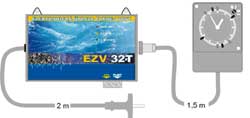 EZV...series). The regularity of changes is derived either from time (e.g. day/night, shift beginning/end, etc.), or from the operation of other devices (e.g. circulating pumps, etc.). The series allows for two-level control by switching an auxiliary contact on the unit. Switching can be operated by a timer (can by included in a delivery) with a 24 or 168 hour switching cycle, by an auxiliary contact of a contactor which switches a circulating pump, by a boiler room or a technological process control system, or by some other device. In the case of control system operation, an auxiliary contact may be replaced with an appropriate interface such as RS 485. Generally, a switching device is required to switch 10mA/25V; max. electronic hard water treatment distance of 100 m. If no switching device is connected, or the auxiliary contact is disconnected, the unit is switched over to flow rate range 1 - see the Table below. The connector used for connecting a switching device is supplied with 12V/10 mA, which may be used, for instance, for supplying a modified timer (delivered by EZV Ltd.). Applications: heat-exchanger plants, common WW treatment in blocks of flats, hotels, warm-water heating systems with circulating pump regulation, some technological equipment, etc.
 series of water treatment units makes it possible to change output signal parameters within a wide range by means of a switch, and thus to optimize the effects of a unit in a wide range of flow rates with regard to treated water properties. Optimization itself may be achieved by long-term observation of effects relative to the level selected, or by suitable water parameter measurements prior to and following the process of treatment, depending on the adjusted values (e.g. conductivity, pH, etc.). The enclosure class for units of this series is IP44. The units are provided with acoustic indicators (open coil circuit or disconnected coil) and relais contacts which are closed when operating correctly (this feature can be used for remote signalling). Relais contact capacity is 1A/125V, however 25 W max. Applications: larger systems (above 2“) with forced circulation, warm-water and hot-water heating systems, steam boilers (water pre-treatment), WW circulation, large swimming pools, process equipment (compressor cooling, oil coolers, etc.) .
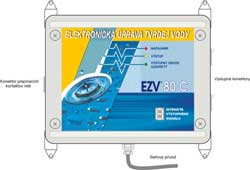 ave to be constant but it can vary (for example during regulation by means of multidirectional mixing valves). The devices exploit time invariance of the physical water treatment (approximately 72 hours) and with particular and appropriate period the devices change the parameters of output signal cyclically covering the wide range of flows of the closed systems. Contrary to the EZV... M devices, it is not necessary to implement additional optimalization of the proper degree setting when using the EZV... C devices. The optimal parameters of the electronic hard water treatment output signal are inherent in the output signal for the particular parameter and the output signal varies constantly in the wide range with the specific and appropriate period. The devices are equipped by the acoustic signalisation and auxiliary relay – the same data refer to the EZV...M devices.
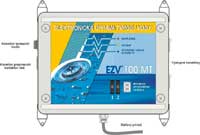 rent values. The regularity, or the dependence of these alterations, may be, similarly to the EZV...T series, derived from time, switching of some other device, or may be given by a control system. The switch for flow rate range1 is used to preset an appropriate level corresponding to an open auxiliary contact, the switch for range 2 is used to preset a level corresponding to flow rate range 2 (with the auxiliary contact closed). By connecting, for instance, a timer it is possible, depending on time, to switch over between two preset flow rate values. Requirements on a switching device capacity are similar to those of the EZV...T series, i.e., 10mA/25V. When switching is operated by a control system, an auxiliary contact may be replaced by a suitable computer interface. The units are fitted with an acoustic indicator, an auxiliary relais (the same data as specified for the EZV...M series), and auxiliary AC voltage 12V/10mA (at the connector reserved for connecting a switching device). The voltage is used, for instance, for supplying a modified timer (delivered by Applications: heat-exchanger plants, WW treatment in larger buildings (dormitories, barracks, etc.), warm-water and hotwater heating systems with circulating pump regulation, larger process equipment, etc.
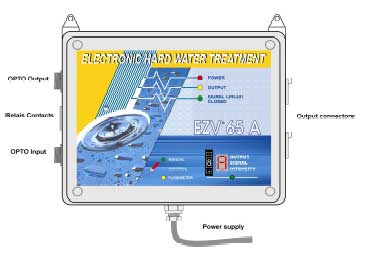 These units are designed for systems with large and irregular flow rate alterations. They require information of a flow rate, i.e., the system must incorporate a flow meter provided with an electric output or with the possibility to connect an appropriate sensor. These units are fitted with controls (only accessible to servicemen) which make it possible to optimize automatically adjusted unit parameters relative to a flow rate and to treated water parameters. Analogically to the EZV...M and EZV...MT series> units, they are provided with a signalling unit and an auxiliary relais. The arrangement of connector outlets and contact capacities are the same. A flow meter is connected via another connector. The Figure illustrates the connection of most frequently used sensors OPTO 1,2, OPTO EZV 1,2 or REED sensors.